Having achieved a third-place finish in the Scottish Premier League and reaching the Scottish Cup Final in the 2000-2001 season, Hibernian were included in the UEFA Cup for the following season.
In the first-round draw they were set to play Greek side AEK Athens, with the first leg scheduled in the Greek capital for early September 2001, and the return leg to take place in Edinburgh later in the same month.
This was Hibs’ first venture into continental competition for seven seasons and due to the club’s relatively impressive historic pedigree in such games, it was eagerly anticipated by supporters of the Leith side, both young and old.
European Pedigree
Hibs supporters are justly proud of their club’s achievements in continental competition. The club’s first foray into competitive European football has become a defining feature of Hibernian Football Club. In 1955, teams from across the continent were asked to take part in the inaugural European Cup by the influential French football magazine L’Equipe, based on their perceived influence in the game.
English champions Chelsea, and Scottish champions Aberdeen were both originally invited, but demurred as they felt it would be a distraction to their domestic seasons. With no team in England accepting this first invitation, Hibs took up the Scottish invite – despite finishing fifth in the previous league campaign – and became the first British club in Europe’s premier club competition.
They recorded victories over Rot-Weiss Essen and Djugardens but were eventually eliminated at the semi-final stage by a Raymond Kopa inspired Stade de Reims 3-0 on aggregate. Stade de Reims eventually lost the final to the soon-to-be all conquering Real Madrid 4-3 at the Parc des Princes in Paris.
After this auspicious opening, the men in green were relative regulars in continental competition. They became the first Scottish club to compete in Europe’s unofficial (not recognised by UEFA) second continental competition, the Inter-City Fairs Cup, in the 1960-61 season.
After defeating Swiss side Lausanne in the first round, Hibs faced two-time competition winners, and holders, Barcelona in the next stage. The game finished 4-4 in the first leg at the Camp Nou, with the prolific Hibs striker Joe Baker switching shirt numbers with a lesser-known team-mate to fool the Barcelona markers and clocking up two of the four goals in the process. In the return leg at Easter Road, a late penalty earned Hibs a famous 3-2 victory, and progress to another European semi-final, where they faced AS Roma.
After a 2-2 draw in Edinburgh and 3-3 draw in Rome, a third game was to be played due to the away goals rule not applying in the Inter-City Fairs Cup (which would have seen Hibs through to the final). This game was again played in Rome, with the home side coming out 6-0 victors. Roma eventually won the tournament, defeating English club Birmingham City in the final.
This wasn’t the end of Hibs’ adventures on the continent, with high profile games in the rest of the 60’s and on into the 1970’s (in both the Fairs Cup and its re-branding as the official UEFA Cup) against the likes of Liverpool (70-71 and 75-76), Leeds United (67-68 and 73-74), Valencia (62-63 and 65-66), Hamburg (68-69), Juventus (74-75) and Standard Liege (89-90).
This period provided some more famous scalps for the Hibs support to reminisce over: a 7-3 aggregate victory over Sporting Lisbon in the 1972-73 European Cup Winners Cup; further Portuguese-flavoured success against FC Porto in the 1967-68 Fairs Cup; and Rosenborg in the 1974-75 UEFA Cup – a 3-2 away victory in Norway followed by a 9-1 drubbing of the visitors in Edinburgh (a club record defeat for Rosenborg).
Perhaps the most noteworthy of these wins came after the beating of FC Porto in the 1967-68 Fairs Cup. Hibs were next paired with Italian’s Napoli. They lost the first leg 4-1 in Naples. At the time, Napoli were at the summit of Serie A, and had only conceded a miserly five goals in their previous six matches. A factor in this mean defensive record may have been them boasting the great Dino Zoff in goals.
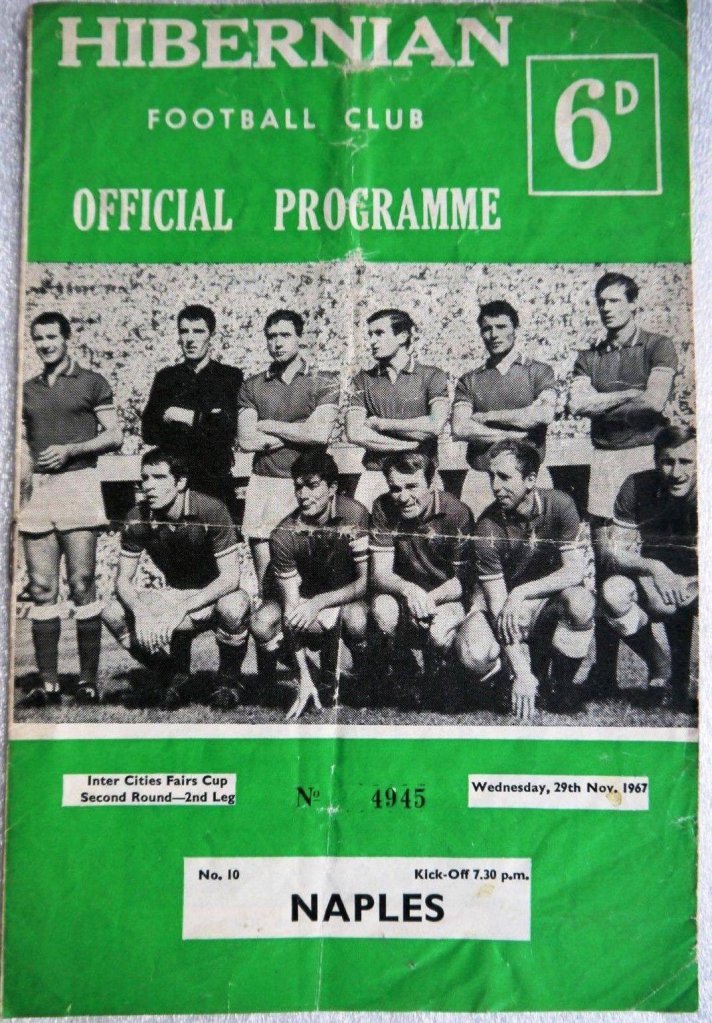
In the return leg however, Hibs triumphed 5-0, to win the tie 6-4 on aggregate. This still ranks as one of the great Scottish performances in European competition and was indeed mentioned by the British press after the hyperbole that surrounded Barcelona’s comeback win over PSG in the Champions League last 16 in the 2016-17 season. With Barca overturning a 4-0 first leg away defeat to triumph 6-1 in Catalonia (and so 6-5 on aggregate), it was rightly pointed out that Hibs had achieved a similar feat in this tie against Napoli and Zoff. Hibs succumbed to Leeds United 2-1 on aggregate in the next round. Leeds would eventually be crowned competition winners.
This was a fruitful period in general for Scottish football in Europe. With Celtic becoming the first British side to win the European Cup in the heat of Lisbon in 1967, and again reaching the final in 1970, before falling victim to the emerging Dutch football powerhouse in the guise of Feyenoord.
Rangers triumphed in the 1972 Cup Winners Cup, after twice being runners up in 60-61 and 66-67. In the Inter City Fairs Cup, the semi-finals were reached by Scottish clubs in three successive seasons in the 1960s: Kilmarnock in 66-67, Dundee in 67-68, and Rangers in 68-69.
Hibernian’s last appearance in Europe, prior to the AEK tie, came in the 1992-1993 iteration of the same competition, where Hibs came up against Belgian royalty in Anderlecht. The first leg in Edinburgh finished 2-2, and a 1-1 draw followed in Brussels, seeing the Scottish side eliminated on away goals, but with plenty of pride in a hard-fought tie. This would be a portent to the games against AEK.
Stay tuned for the next part of Liam’s ‘Hibs in Athens’ series where he builds up to recalling the AEK Athens tie in the 2001 UEFA Cup.
Header image credit Hibernian FC.

 The East Stand